
Specialty Wet Forming

Vegetable Tanned Sheep Skin
This is where tradition meets sculpture. Vegetable-tanned sheepskin responds beautifully to water, pressure, and the hand of the maker, allowing me to push leather into bold dimensional forms with remarkable definition.
It has enough body to create dramatic structure while still allowing me to manipulate folds, contours, faces, and organic shapes by hand.
Italian Vegetable Tanned Sheep Skin
Thin, supple, and beautifully refined, Italian vegetable-tanned lambskin brings a different character to sculptural forming.
Its fine grain and delicate hand allow me to capture subtle contours and intricate details while retaining the warmth and natural character that make vegetable-tanned leather so special.
For pieces where elegance and sculpture need to coexist, this is an extraordinary material.
Chrome Tanned Lamb Skin
This is where things get interesting.
Chrome-tanned garment lambskin is extraordinarily thin, soft, and fluid—sometimes behaving more like fabric than what most people imagine leather to be.
Traditionally, that softness is its greatest strength.
For me, it became the challenge.
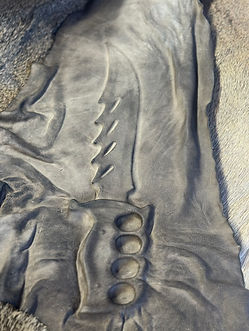
Through my independently developed proprietary locking process, I can take this flowing material, form it into complex three-dimensional geometry, remove the mold, and leave behind a hollow leather sculpture capable of holding its own form.
No permanent mold. No hidden rigid support.
Something that was made to drape—taught to stand.



About my Specialty Wet Forming
Sculptural Wet Forming
Where leather stops covering the form—and becomes the form.
There is something almost unnatural about taking a flat piece of leather and convincing it to become something else.
A face. An animal. A piece of anatomy. A form that seems to emerge from the hide itself.
My journey into sculptural wet forming began when I observed a bag with a solemn woman's' face. I desperately tried to recreate what I had seen (Top left picture of the red face pouch) and in an instant knew what path my leather career was to go. I sought out any information I could find on wet molding leather, but there was no one who could guide me. I contacted the maker of that bag, and was informed they were in the final stages of terminal cancer. I offered my condolences, told the brother how much that piece impacted me and thanked them for sharing something that inspired me. Then I began to seek out others, until I stumbled across a man doing exactly what I was so obsessed with. I took a chance and reached out to him, and from there a mentorship and friendship began. Under the instruction of my mentor; with a background in leather, fashion, costume work, and sculpture, he taught me to look beyond traditional leathercraft and understand leather as a material that could be stretched, compressed, folded, manipulated, and sculpted.
Under his instruction, I learned the foundations of wet forming—the relationship between moisture, tension, pressure, depth, detail, and the natural movement of the hide.
But eventually I encountered a question I had to answer for myself:
How do you make the leather stay?
That question sent me down the rabbit hole.
Different leathers. Different techniques. Failed experiments, partial successes, ruined pieces, and countless hours studying what the leather was doing—and, more importantly, why it was doing it.
Eventually, I found my answer.
The Lock
Through that experimentation, I developed my own proprietary process for locking sculpted leather into its three-dimensional geometry.
My process is not my mentor's process. I do not know his formula or use his proprietary method. What I developed grew from my own experimentation, built upon the wet-forming knowledge and principles I learned during my apprenticeship. I discovered one method, but it was lacking the sophisticated detail my mentor achieved.
On September, 24th, 2026, after watching a Documentary my mentor sent to me, something clicked and I had an epiphany. I revised my locking technique, tested it, and discovered the method that gave the results I had so desperately sought out.
The exact locking process remains proprietary and is known only to me.
And what makes it particularly unusual is what isn't inside the finished sculpture.
I am not permanently gluing leather over a plastic form or leaving a rigid mold hidden underneath it. The mold is a temporary tool used to create the geometry. Once the leather has been formed and locked, that mold is removed.
What remains is hollow, self-supporting leather.
No permanent mold. No hidden rigid support. The leather itself becomes the structure.
From Imagination to Leather
Before I can form the leather, I need something to form it over.
That often begins with an original idea developed specifically for the piece I'm creating. I design my sculptural forms and produce my molds in-house using 3D-printing technology, allowing me to create geometry specifically around the way leather needs to stretch, gather, and move.
That freedom changes what is possible.
A face emerging from a witch's hat. An animal seemingly breaking through a bag. Human anatomy incorporated into armor. A sculptural element designed around the story of one particular commission.
The mold gives me the geometry.
My hands still have to convince the leather to accept it.
And that's where the real work begins.
As a flat hide is worked across complex three-dimensional geometry, tension builds. Material gathers. Folds appear. Every movement in one area changes what happens somewhere else.
Some folds have to disappear. Others are carefully driven beyond the finished sculpture. And sometimes the tension itself becomes part of the artwork—broad folds radiating from the sculpture as though something beneath the leather is trying to break through.
There is no button to push that does this part.
It is done by hand.
Three Leathers. Three Personalities.
Depending on the sculpture, I work with vegetable-tanned sheepskin, Italian vegetable-tanned sheepskin, and exceptionally thin chrome-tanned garment lambskin (1 mm or less). The orange deer listed is .64 mm.
Each behaves differently.
Vegetable-tanned sheep gives me body and bold sculptural structure. Italian vegetable-tanned lamb offers refinement, beautiful grain, and delicate detail. Chrome-tanned garment lamb presents an entirely different challenge—a remarkably thin, flowing leather originally intended to drape against the body.
My proprietary process allows me to take that softness and fluidity and transform it into lasting sculptural geometry.
Something that was made to drape—taught to stand.
I don't believe one leather is inherently better than another.
I choose the leather according to the sculpture—not the sculpture according to the leather.
One-of-a-Kind Work Requires One-of-a-Kind Pricing
Sculptural wet forming cannot realistically be reduced to a simple price chart.
Every project presents its own artistic and technical challenges, and each sculptural commission is priced individually. Then there is the item the sculpture is attached to, all my products are made by hand, hand stitched, painted with an airbrush or by hand, and custom fit to the client, so the sculpture alone is only a part of the overall project.
The size of the mold and complexity of the geometry are two of the largest factors. A small, shallow relief with broad features is an entirely different undertaking from a large form with deep projection, facial anatomy, fine details, difficult transitions, or multiple sculptural elements.
The selected leather, original mold development, 3D-printing requirements, depth of relief, finishing, painting, integration into the final piece, and the amount of hand manipulation required all contribute to the final cost.
Some molds may become part of my working collection.
Others may be designed and created for one client, one commission, and one story.
That is why these projects begin with a conversation rather than a price tag.
You should have a budget in mind so that I can do my best to work within that budget.
Made in the Lair
From the first idea to the digital design, the physical mold, leather selection, hand forming, locking, coloring, finishing, and final construction, this process allows me to take an image that once existed only in my head and give it physical form in leather.
It is part traditional leathercraft, part sculpture, part engineering—and a great deal of experimentation.
I'm proud of where the knowledge came from. I'm proud of the apprenticeship that gave me the foundation to pursue it. And I'm equally proud that when I reached the edge of what I had been taught, I kept experimenting until I found a path of my own.
The result is not leather covering a sculpture.
The leather is the sculpture.
Some techniques are meant to be shared.
Some secrets stay in the Lair.
If you are interested in a custom piece that cannot be duplicated by anyone, contact me. You won't regret it.


Contact
Like what you see? Get in touch to learn more.


